

Rosemary Oil & Hair Growth: What the Science Actually Says Rosemary mint
Introduction
If you’ve searched Google or scrolled through social media in the past two years, you’ve seen it. Rosemary oil for hair growth has become one of the most-searched natural haircare topics in Canada — and across North America. Google Trends data shows search interest for rosemary essential oil surging 77% between 2024 and 2025, far outpacing competing natural oils in the hair growth category.
People are applying it directly to their scalps, layering it into their shampoos, and reporting real results. Some claim meaningful regrowth within months.
As a pharmaceutical scientist, I understand both the excitement and the scepticism. So I went through the clinical research. What I found is more substantive than the social media hype — and more nuanced than a blanket dismissal.
Here is the honest, evidence-based answer.
What Is Rosemary Oil, and Why Does It Keep Coming Up?
Rosemary (Rosmarinus officinalis) is a Mediterranean herb with a long history in both culinary and medicinal use. The essential oil extracted from its leaves contains a range of bioactive compounds — among them ursolic acid, rosmarinic acid, and caffeic acid — that have been studied for anti-inflammatory, antioxidant, and circulation-enhancing properties.
The hair growth interest is not new. Traditional medicine systems in North Africa and the Middle East have used rosemary topically for scalp health for centuries. What is new is the clinical evidence.
The Study That Started the Conversation
In 2015, a randomized comparative trial published in Skinmed compared rosemary oil directly against minoxidil 2% — the most widely used over-the-counter hair loss treatment — in patients with androgenetic alopecia (the most common form of hair loss in both men and women).
The result: rosemary oil produced comparable hair count increases to minoxidil 2% at the six-month mark.
That is not a minor finding. Minoxidil has decades of clinical backing. The fact that a botanical oil matched it — in a controlled trial — is significant.
Critically, the rosemary group reported fewer side effects. Scalp itching, the most common complaint with minoxidil, was reported significantly less frequently in the rosemary arm of the study.
How Does It Work?
The proposed mechanism centres on circulation and follicle environment.
Improved scalp microcirculation. Rosemary oil is believed to inhibit an enzyme called 5-alpha reductase, which converts testosterone into dihydrotestosterone (DHT) — the hormone responsible for follicle miniaturization in androgenetic alopecia. Separately, rosemary’s active compounds appear to promote vasodilation, improving blood flow to the scalp and the nutrient delivery that follicles depend on.
Anti-inflammatory action. Chronic low-grade scalp inflammation is increasingly recognized as a contributor to hair thinning. The rosmarinic acid in rosemary oil has demonstrated meaningful anti-inflammatory activity in multiple studies.
Follicle stimulation via nerve growth factor. A 2013 study by Murata et al. demonstrated that rosemary leaf extract stimulated hair growth in mice by inhibiting the binding of DHT to androgen receptors — pointing to a direct follicular mechanism beyond circulation alone.
None of these mechanisms are theoretical. They are supported by published research, even if the evidence base is not yet as deep as that supporting pharmaceutical treatments.
Who Is It Most Likely to Help?
The clinical evidence is most relevant for:
-
Androgenetic alopecia (pattern hair loss in men and women)
-
Diffuse hair thinning related to scalp inflammation or poor circulation
-
Postpartum hair shedding, where improving scalp environment may support recovery
-
Stress-related hair loss (telogen effluvium), as a complementary approach to overall scalp health
It is important to be clear: rosemary oil is not a replacement for medical evaluation in cases of significant or sudden hair loss. If you are experiencing rapid shedding, patchy loss, or scalp pain, consult a physician or dermatologist. There are conditions — alopecia areata, thyroid dysfunction, nutritional deficiencies — that require targeted medical treatment.
For diffuse thinning, gradual pattern loss, or general scalp maintenance, rosemary oil is one of the better-evidenced natural options available.
Realistic Expectations: What the Timeline Actually Looks Like
This is where most social media content fails people.
Hair growth is biologically slow. The anagen (growth) phase of a follicle cycle operates on a timeline of months, not days. In the 2015 Skinmed trial, meaningful hair count differences between baseline and treatment groups were not observed until the six-month mark.
|
Timeframe |
What to Expect |
|
Weeks 1–4 |
Scalp may feel less itchy or irritated; no visible change in density |
|
Months 2–3 |
Some individuals report reduced shedding; no significant regrowth yet |
|
Months 4–6 |
Early density changes may become visible for those who respond |
|
Months 6–12 |
Most meaningful outcomes visible in positive responders |
Consistency matters more than frequency. Daily or near-daily application, properly delivered to the scalp, is more effective than occasional heavy use.
Expecting visible change in under four weeks is not consistent with hair growth biology.
How to Apply a Scalp Oil Correctly
Most people use scalp oils incorrectly — either applying them to the hair shaft rather than the scalp, or using so much product that the scalp becomes occluded rather than nourished.
The correct approach:
-
Part the hair to expose the scalp directly — ideally in multiple sections
-
Apply directly to the scalp, not the hair
-
Massage gently with fingertips for 2–4 minutes to stimulate circulation
-
Leave on for a minimum of 30 minutes before washing, or overnight for deeper absorption
-
Consistency: aim for 3–5 applications per week
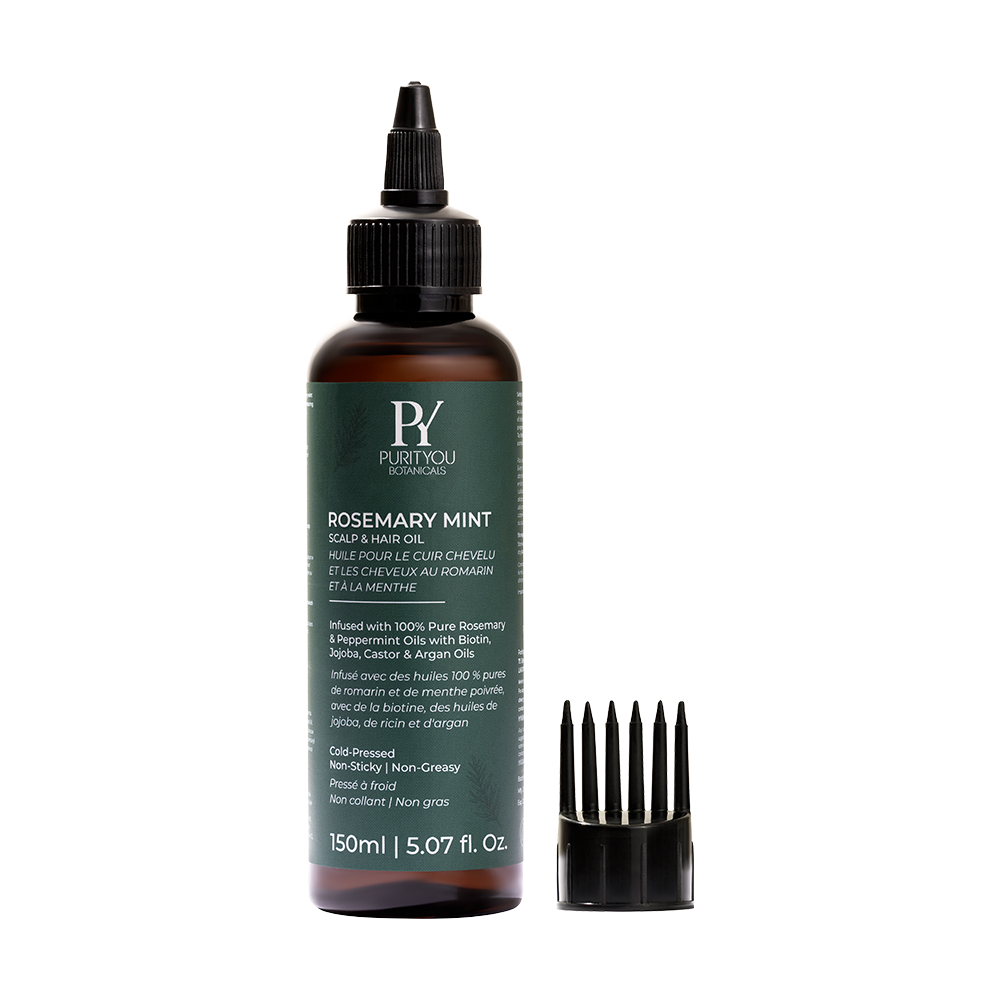
The applicator matters. A standard dropper often delivers product onto the hair, missing the scalp entirely. A precision comb-tip applicator changes this — it parts the hair and deposits the formula exactly at the root, directly onto the follicle-bearing scalp tissue, without waste.
Frequently Asked Questions
How long does rosemary oil take to work for hair growth?
Based on the clinical evidence, a minimum of 90 days of consistent use is needed to assess whether you are a responder, with meaningful outcomes more commonly observed at the six-month mark.
Can I use rosemary oil if I colour or chemically treat my hair?
Yes. Rosemary oil is applied to the scalp, not the hair shaft, so it does not interact with colour or chemical treatments when used correctly.
How often should I apply rosemary scalp oil?
Three to five times per week, applied directly to the scalp with a gentle massage. Daily use is appropriate if well-tolerated.
Why isn’t one or two weeks of use showing results?
Hair growth biology operates on a months-long cycle. Expecting visible change in under four weeks is not consistent with how follicles work.
Should I use pure rosemary essential oil or a diluted formula?
Never apply undiluted essential oil directly to the scalp — it can cause significant irritation or chemical burns. Always use a properly formulated scalp oil where rosemary is diluted in carrier oils such as jojoba or castor oil, at a concentration of approximately 2 to 5%.
Can rosemary scalp oil be used alongside minoxidil?
There is no known negative interaction. Some individuals use both. If you are currently using minoxidil or any prescribed hair loss treatment, consult your pharmacist before introducing any new topical product.
Our Rosemary Mint Scalp & Hair Oil was specifically formulated for direct scalp application. The comb-tip applicator delivers the formula precisely where follicles need it most — without waste, without mess. Rosemary and castor oil work in combination: one to support circulation, one to nourish and protect the follicle environment. That is formulation with intention.
References
1. Panahi Y et al. Rosemary oil vs minoxidil 2% for the treatment of androgenetic alopecia: a randomized comparative trial. Skinmed. 2015;13(1):15–21.
2. Murata K et al. Promotion of hair growth by Rosmarinus officinalis leaf extract. Phytotherapy Research. 2013;27(2):212–217.
3. Hay IC, Jamieson M, Ormerod AD. Randomized trial of aromatherapy: successful treatment for alopecia areata. Archives of Dermatology. 1998;134(11):1349–1352.